

From the show floor to strategic clarity
CES® 2026 marked a decisive shift from experimentation to execution. Across the show floor, technologies that once lived primarily in concept decks and pilot programs were operating in real environments. According to the Consumer Technology Association, CES 2026 welcomed more than 148,000 attendees from around the globe, with more than 55 percent at senior executive level. With over 4,100 exhibitors and approximately 1,200 startups spanning a massive 2.6 million square feet, CES no longer felt like a preview of what might be coming. It felt like a working model of what is already underway. What mattered most, however, was not any single product, booth, or breakthrough. What stood out were a set of converging signals visible across demos, executive reactions, and carefully curated experiences. Together, they pointed to how AI, robotics, sensing, and platforms are coming together into intelligent systems that are increasingly practical, physical, and operational. Through Sprosty Executive Immersion Experiences at CES 2026, senior leaders encountered these shifts firsthand. The six insights below reflect not only what executives saw, but what consistently sparked deeper conversation and strategic reflection.
Six AI Signals from Our Executive Immersion Experiences
1. AI Is Moving Into the Physical World
At CES 2026, AI was no longer confined to dashboards, copilots, or analytical tools. It was embodied. Executives encountered AI embedded into robots, environments, and physical systems that responded in real time. 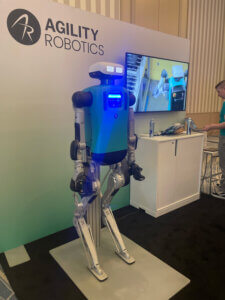 Examples included Unitree’s humanoid robots demonstrating balance and coordinated movement, Sharpa’s AI agents operating across human and robotic interaction, and Hypervsn’s holographic displays turning digital intelligence into spatial experiences. What felt different this year was not novelty but presence. AI did not require an explanation to be understood. It interacted directly with people, not through abstraction, but through movement, responsiveness, and physical engagement. Why it matters: AI is becoming a participant in physical environments. This shift has meaningful implications for frontline work, operations, training, and customer engagement. Leaders must now consider how intelligent systems behave, not just what they compute.
2. Robotics Are Advancing Faster Than Their Use Cases
Robotics progress was unmistakable across CES 2026. Improvements in dexterity, balance, and real-time responsiveness were evident across multiple demonstrations and noticeably more refined than in prior years.  Executives experienced advances from companies such as Unitree, Agility Robotics, Hyundai Boston Dynamics, and Deep Robotics. At Sharpa’s booth, the pace of advancement was especially tangible. Alicia Veneziani, Global VP of Go-to-Market and President of Europe at Sharpa, guided executives through a series of live demonstrations that showed how far robotic capability has progressed year over year. These included a ping pong–playing robot, a blackjack-dealing robot, and a precision dexterity system capable of executing tightly controlled folding movements that formed a functioning handheld windmill. What stood out was not spectacle, but clarity. The demonstrations made progress legible. What had improved, what was now possible, and where constraints still existed were all clearly articulated. The steady congestion around both Unitree and Sharpa’s booth reflected the same conclusion many executives were reaching. Robotics capability is accelerating, even if broad deployment remains selective. Why it matters: While robotics technology is advancing rapidly, near-term value remains concentrated in task-specific automation. The opportunity is not general-purpose humanoids everywhere, but robots deployed where they meaningfully reduce friction, risk, or cost.
3. Digital Twins Are Becoming Control Systems
Digital twins at CES were no longer positioned primarily as visualization tools. Instead, they emerged as coordination layers that connect sensing, planning, energy management, and execution.  Executives saw this evolution through demonstrations linking digital twins directly to operational decision-making for supply chains, as well as Korea Hydro & Nuclear Power’s (KHNP) system-level future energy models focused on coordination and optimization. A recurring executive reaction was pragmatic. Visibility alone no longer creates value. Value emerges when visibility is paired with closed-loop decisioning that can influence outcomes in real time. Why it matters: Digital twins are quickly becoming the operating systems of complex environments. They enable leaders to test, train, and optimize before acting in the physical world, reducing risk while increasing speed.
4. Edge Intelligence Is Becoming Essential
Some CES demonstrations felt slower than expected, not because the technology lacked sophistication, but because latency disrupted the illusion of intelligence.  The most compelling experiences relied on edge intelligence, where inference happens on-device rather than in the cloud. These included vision-based robotics, real-time interactive environments, and consumer-facing experiences that demand immediate responsiveness. As Sprosty founder, Dave Sprosty explained, “Latency and inference improvements may feel incremental today, but they compound quickly. Like a penny that doubles every day, what seems negligible at first becomes transformational faster than most organizations expect. What felt constrained this year may soon feel seamless.” Why it matters: Trust, autonomy, and responsiveness depend on edge intelligence. As inference performance improves, edge-enabled systems will move quickly from impressive to indispensable across both operational and consumer contexts.
5. Personalization Is Table Stakes. Trust Is the Differentiator.
Personalization was everywhere at CES 2026, particularly across health, wellness, and consumer-facing technology. What stood out was not simply how tailored experiences have become, but the very different forms trust now takes depending on context.  Executives explored a wide range of personalization approaches, from lightweight customization to deeper, biometric sensing. At one end of the spectrum was Aquablu, a Netherlands-based company reimagining the traditional water cooler. Their Red Dot Design Award–winning dispenser allows users to personalize hydration in real time by adding protein, vitamins, caffeine, or flavor. The experience feels personal, but it is deliberately non-invasive. No biometric data. No behavioral tracking. Trust is built through simplicity, transparency, and design restraint. At the other end of the spectrum were systems like Ceragem’s biosensing wellness devices, which can detect physiological signals such as stress levels and other biometric indicators. These experiences are deeply personal by nature. They require users to believe not only in the efficacy of the technology, but in the integrity of the company behind it. What became clear through executive discussion is that personalization itself is no longer the differentiator. Leaders expect it. What varies is the level of trust required to deliver it. Why it matters: As personalization becomes ubiquitous, organizations must be deliberate about how they earn trust. In some cases, that means designing systems that do less. In others, it means establishing clear, ethical frameworks for handling the most sensitive data consumers have. The competitive advantage will belong to companies that understand the difference.
6. Organizational Design Is the Hidden Advantage
Across nearly every executive conversation, one truth became clear. Innovation velocity is increasingly an organizational capability.  This insight crystallized during the Panasonic experience, where Elise Neel, SVP and Head of Panasonic Go, guided executives through the company’s journey toward becoming a more AI-first operating model. Her discussion was both strategic and operational, grounded in how small, empowered teams and structural flexibility enabled faster experimentation inside a legacy organization. What resonated most was not the sophistication of the technology, but the clarity of intent behind it. Panasonic’s progress was not accidental. It was designed. As one executive reflected during the debrief, this was less about having better tools and more about creating the conditions where teams can actually use them. Stepping back from the cumulative experiences of the week, another signal became harder to ignore. As a woman who has walked this show floor year after year, it was energizing to see more female founders, operators, and AI leaders visibly shaping the conversation at CES 2026. Not as a headline, but as a lived presence. Leaders like Elise Neel at Panasonic and Alicia Veneziani at Sharpa were not presented as exceptions. They were simply the right people to explain complex systems, guide executive dialogue, and drive change. That matters. Because who is building, operating, and explaining intelligent systems influences how those systems are designed, deployed, and trusted. Why it matters: Technology access is no longer the constraint. Organizational design, leadership, and perspective determine how quickly insight becomes action.
From Signals to Strategy
CES does not deliver finished solutions. It surfaces early signals. The leaders who benefit most are those who get to experience emerging technology firsthand, create space for executive sensemaking, and act intentionally rather than reactively. That is why organizations engage Sprosty to design Executive Immersion Experiences that turn CES into clarity. Not by just seeing more, but by seeing more of what matters. 👉 Learn more about Sprosty’s Executive Immersion Experiences