
The Challenge
EnergyCo, a complex, multi-state regulated utility operating across diverse customer and regulatory environments, had long been admired for operational strength. Its reputation rested on infrastructure, grid reliability, and financial discipline. Investor calls focused on rates, capital programs, and earnings per share. By all traditional measures, EnergyCo was a success.
But customers did not see it that way. Despite reliable service delivery rates that were 35% lower than the national average, EnergyCo’s customer satisfaction scores were near the bottom of its region. In fact, small-business CSAT was rated a “D–,” and overall satisfaction ranked 17th among its peers. Customer complaints were consistent: outages were communicated sporadically, bills were confusing, the website and mobile app were outdated, and call centers were fragmented and lacked empowerment. Frontline teams were often left to absorb the consequences of this friction every day, without clear visibility into root causes or the ability to address them at the source. As a century-old utility, the company long referred to those it served as “ratepayers,” reflecting an era when people were viewed primarily as bill payers rather than as communities.
The issues went beyond perception. Regulators began pressing EnergyCo during rate cases, questioning how the utility could justify increases when satisfaction was so low. Executives were asked to reconcile strong financial performance with consistently poor customer experience.
“We quickly learned that we were an operationally focused company instead of a customer-centric company. Everything we focused on was about getting things done faster in the field, with very little focus on the customer. The journey had to start with a mindset change, which was not easy for us when we were a 115-year-old organization.”
-EnergyCo Executive Sponsor
EnergyCo’s leaders recognized that incremental fixes would not be enough. They could not solve these challenges with a new call script or a fancy app layered on top of old systems. What was required was a cultural reset, a fundamental reorientation of the company around the customer.
The Solution
What followed was not a single initiative but a shift in how the organization listened, aligned, and acted. EnergyCo began turning customer and employee signals into shared understanding, and that understanding into coordinated action across the business.
EnergyCo began a multi-year transformation to rebuild itself around the customer. The work unfolded in phases, each designed to address specific pain points while building the cultural and organizational foundation for lasting change.
From Signal to Coordinated Action
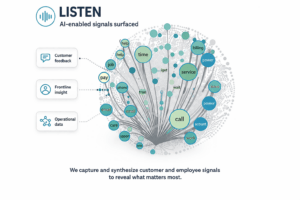
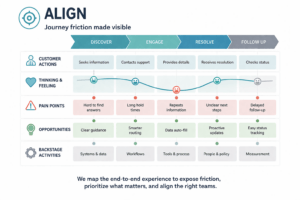
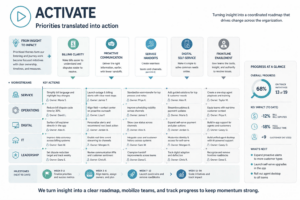
EnergyCo’s transformation followed a consistent pattern: strengthening how the organization listened, aligning around what mattered most, and activating change across functions.
Phase 1: Start Measuring, Stabilize, and Modernize the Call Center
The first step was to strengthen how the organization listened and surfaced customer signals, and to understand what was really happening across customer interactions and the frontline experience. This came from internal interviews with dozens of customer-facing team members who cited agonizing examples of when they let their customers down. The level of engagement from the field teams reflected their passion and empathy for their customers, leading to a desire for Voice of the Customer through Employees.
The call center was where customer frustration was most evident. A leading customer-satisfaction benchmark firm found that EnergyCo lagged competitors in professionalism, issue resolution, and IVR containment. Customers and team members echoed this sentiment:
“No customer makes it out of the IVR system happy.”
“The autopay function is too hard to use.”
EnergyCo responded with a call center transformation program.
- Establish KPIs and real-time customer dashboards. Customer pain points were documented, and new call center metrics were directly tied to them, giving teams visibility into both efficiency and customer satisfaction.
- Training for empathy and resolution. Frontline reps received competency development that emphasized listening, ownership, and issue resolution rather than call handling speed alone.
- Charters for accountability. Each customer-facing team developed an internal “charter” defining its role in the overall customer experience.
- IVR System enhancements. This included end-to-end diagnosis, early use of AI to improve workforce management and better match resources to customer demand, Power BI Dashboards, NPS, and fallout improvements.
- Cross-center best practices. Processes were standardized and improved across multiple centers.
Within a year, the call center instituted Net Promoter Score. They saw marked improvements in overall service level and 1st call resolution. Call volume declined by double digits as customers migrated to new channels, such as the mobile app and IVR. For the first time, EnergyCo’s call centers were viewed as a place to resolve problems, not a source of new frustrations. Over time, these capabilities helped the organization better detect patterns in customer interactions and respond more quickly to recurring sources of friction. NPS improved to the 40–50 range, which is strong for utilities, where benchmarks typically range from 0 to 30.
Phase 2: Use Customer Journeys to Redesign Billing, Outage Communication, and Digital Touchpoints
With clearer signals in place, the next step was to align teams around the moments that mattered most in the customer journey, starting with billing and digital touchpoints, which consistently drive the most customer dissatisfaction. Bills were confusing, autopay was unreliable, and outage information was scattered. Website and customer touchpoint improvements were not prioritized, making funding difficult. EnergyCo involved team members, from Customer Service Representatives to linemen to IT developers, in a structured Customer Experience Journey Mapping (CXJM) process and mapped every step of the residential and business billing journey, from account creation to payment and dispute resolution. This work created a shared view of where friction concentrated across the end-to-end experience and helped teams align on what mattered most.
Four key changes followed:
- Higher prioritization of digital CX projects: An accelerated digital roadmap was created based on customer pain points and the funding and resources flowed accordingly
- Digital touchpoint upgrades. Autopay was reengineered, a billing FAQ was added, and outage tracking was transformed by the launch of a real-time outage map integrated into new mobile app features.
- Simplified bill formats. Customer usability testing informed the development of clearer, easier-to-read statements.
- New payment options. Customers were given more flexible arrangements and communications protocols.
Involving the field team in mapping pain points and designing improvements drove immediate results and made them part of the change management. Outage-related call volume declined as customers began using the real-time outage map. Digital engagement spiked, and billing-related complaints dropped.
“The unique process for journey mapping was incredible, and we still use that today. I often ask, what did our customer journey show about the pain points of billing, and have we resolved those? Even four years later, that discipline is still paying dividends.”
-EnergyCo Executive
Phase 3: Expand Across the Enterprise via the Use of Customer Feedback Loops
As alignment improved, the organization began implementing change more consistently across functions. The wins in the call center and billing demonstrated the value of the approach, creating momentum to expand customer-centricity across the enterprise.
- Customer feedback loops. Customer input was continuous and systematically embedded into campaign planning, outage communications, and technology decisions.
- CX charters and scorecards. Every function, from marketing to technology, to fieldworkers, developed explicit customer-facing charter accountabilities.
- Board engagement. Executives began referencing customer metrics and progress in investor briefings and board discussions, placing experience alongside financial results.
- Training for leaders. Operations and technology managers received training in Voice of the Customer through Employees (VoCE) insights.
“This industry was built from a financial perspective, which explains how we ended up without the customer at the center. Times are different now. Modernizing created an opportunity-rich environment to make progressive changes in how we relate to customers. Part of that was simply referring to people as customers, not ratepayers.”
-EnergyCo CMO
The expansion work demonstrated that customer centricity was not just a call center or billing issue, it was an enterprise opportunity.
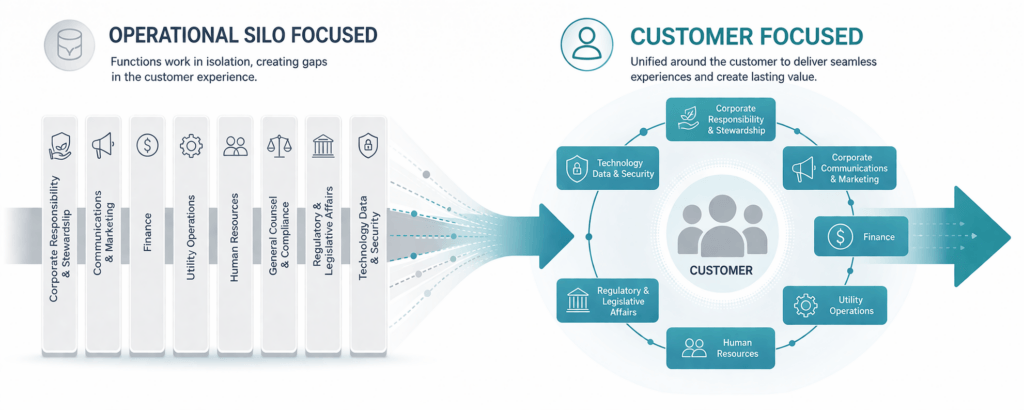
The Cultural Shift: From Siloed Operations to Customer Focused
The final and most enduring change was cultural. EnergyCo embraced customer centricity not as a program, but as the new operating model. Senior leaders led a unified effort to weave customer centricity through the fabric of their company, which started with CEO support and included an STI program.
- Cross-functional teams replaced siloed operations.
- Technology was reorganized into product lines
- Customer goals were embedded into performance evaluations and dashboards.
- Employees were empowered to act on customer needs and celebrated when they did.
- The language changed, as customers were no longer called ratepayers.
“I’m really excited about the messages on customer centricity. We are here to serve customers, communities, and everyone we touch. It is not just a call center issue or a website issue. It is an outside-in mentality across the company. How would our customers view us? What would they like to see? ”
-EnergyCo CEO
“Honestly, it has changed the way we work. The biggest win is relationships. We put people together who had been siloed for years, and now it is just the way we operate.”
-EnergyCo Employee
By 2024, and even more clearly today, EnergyCo’s transformation was visible. The company earned top workplace recognition both in their home state and nationally, including Forbes’ Best Employer rankings and a USA Today Top Workplaces designation. At the same time, sustained grid investments in automation and resilience were delivering measurable reductions in customer interruption time. What began as a cultural shift inside the company is now showing up externally; in how employees engage, how the system performs, and how the company is recognized. The impact of this shift was visible across customer experience, operations, and the organization.
Results and Impact
The results reflected more than isolated improvements; they showed what happens when customer and employee signals are translated into aligned, cross-functional action.
Customer Experience Gains
- CSAT improved from 17th in the region (D–) to #2.
- Call center NPS was introduced and improved to 40–50, sustained above typical utility benchmarks.
- Outage communication became faster and clearer, reducing customer confusion and friction during high-stress moments.
- Mobile app downloads increased significantly, and engagement surged with the launch of the real-time outage map.
- Call center volume dropped by 17%, accompanied by marked improvements in overall service level and 1st call resolution.
Operational and Financial Impact
- System hardening and automation investments resulted in approximately 320 minutes of interruption saved for the average impacted customer.
- Regulatory credibility improved, as customer satisfaction underpinned rate case discussions.
- Customer metrics became as visible as financial results in executive reporting.
- A major ERP deployment, typically a source of significant customer disruption, was executed smoothly, with minimal impact on the customer experience. This reflected stronger cross-functional coordination and a more proactive focus on the customer.
Organizational Transformation
- Significant improvement in prioritization of customer experience initiatives, funding, and speed to market
- Cross-functional collaboration became the default.
- Customer-centric language and expectations were embedded across onboarding and evaluations.
- Employees had new tools, processes, and empowerment to act in the customer’s interest.
One year after the engagement, EnergyCo leaders were surveyed to understand what had changed most. The themes that surfaced most frequently reinforce where the transformation had its deepest and most durable impact.
Where Leaders Saw the Greatest Impact
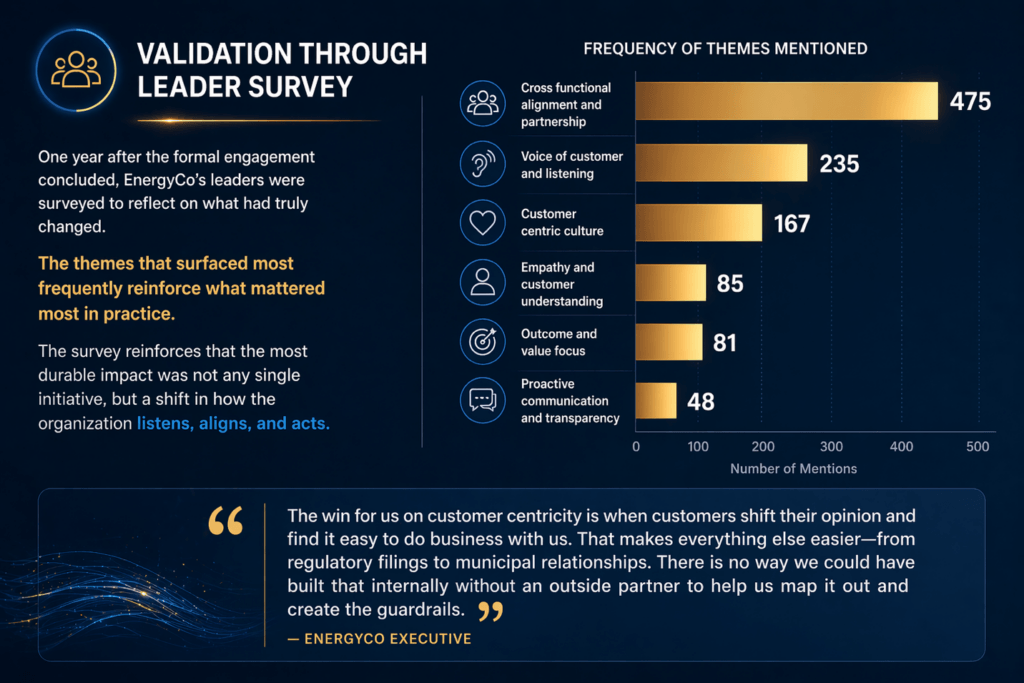
The survey reinforced that the most durable impact went beyond any single initiative; it was a shift in how the organization listened, aligned, and acted. Leaders most frequently pointed to cross-functional alignment, stronger listening, and a more customer-centric culture as the defining changes.
“The win for us on customer centricity is when customers shift their opinion and find it easy to do business with us. That makes everything else easier, from regulatory filings to municipal relationships. There is no way we could have built that internally without an outside partner to help us map it out and create the guardrails.”
-EnergyCo Executive
What This Shows
EnergyCo’s experience reflects a broader pattern across utilities and telecom providers. Progress accelerated when the organization strengthened how it listened to customer and employee signals, aligned around the moments that mattered most, and activated change across functions with clear ownership. These same disciplines are increasingly defining customer-centric operating models in regulated industries today.
For leaders, the implication is clear: customer centricity becomes real when it shapes how the organization operates, how it prioritizes, how it aligns, and how it turns insight into coordinated action.