

How COVID-19 Could Be Saving Lives by Accelerating Remote Patient Monitoring for Eldercare and Chronic Disease Management
How does COVID-19 affect the future of remote care? In March, the FDA issued a new policy allowing more latitude to use non-invasive devices to measure vital signs to address the coronavirus outbreak. Such devices allow healthcare providers, already strained from battling COVID-19, to monitor vital signs remotely. A few examples of what can be measured include body temperature, blood pressure, heart rate and respiratory rate. Providence Health (Renton, WA) is an example of a hospital system using remote patient monitoring (RPM) to care for and track the progress of over 700 COVID-19 patients. This approach decreases the strain on healthcare providers.
COVID-19 Is Accelerating Several Trends That Will Influence Remote Care
One of the most significant trends in patient care has been the shift to a digital-first mindset. Digital therapeutics that are being used to help with the diagnosis, treatment and prevention of diseases or disorders are being embraced at an extraordinary rate and not just from companies with which they have had a history of doing business.
Consumers are rapidly adopting digital options and trying new brands and channels (read: digital) as they try to access the products they need. A recent study revealed that during the pandemic, 50% of consumers are trying new brands, products and channels. More importantly, consumers will likely engage after the pandemic with companies that served them well during the pandemic. As a result, businesses are identifying trends, being more aggressive experimenting their way towards a solution, and using customers as very willing “beta” testers of new products and means of doing business.
Almost overnight, we have seen a shift to Virtual Living. This trend is unlikely to transition back post COVID-19 and is driving even the strongest leaders to innovate the way they do business – not just opportunistic innovation capitalizing on low hanging fruit, but systematic, responsive innovation that uses proven innovation processes to fundamentally evolve the way they operate and how they service customers. Those companies that can deliver winning customer experiences and establish trusted relationships with customers during COVID-19 will earn the right to service customers long into the future.
Remote patient monitoring and the broader connected health markets is an example where digital disruption is accelerated by COVID-19 and the result has the opportunity to be a better customer experience, result in better overall care and quality of life and broader (and faster) access to the best medical technology and treatment.

How Does Treating COVID-19 Relate To Chronic Disease Management And Eldercare?
While there are several categories of health monitoring devices and services, this article addresses solutions for chronic disease management and eldercare (aka Aging in Place). The first category, remote patient monitoring, is used mostly in the delivery of ongoing health maintenance or treatment related to a chronic disease state under the supervision of a health care professional. The second category of solutions are designed to support caregivers and those receiving that care with the goal of more people who need care to be able to stay in their own homes longer. Both of these forms of monitoring aim to identify trends and real time anomalies to ensure rapid response when something goes wrong.
Pre-COVID-19, the combined patient monitoring market was growing at a CAGR of 16% (technavio). With limited access to the healthcare system that is struggling to meet the demand for COVID-19 patients, remote patient monitoring is being used for everything from diabetes and heart disease to medication management.
Remote Patient Monitoring for COVID-19 and Chronic Disease Management
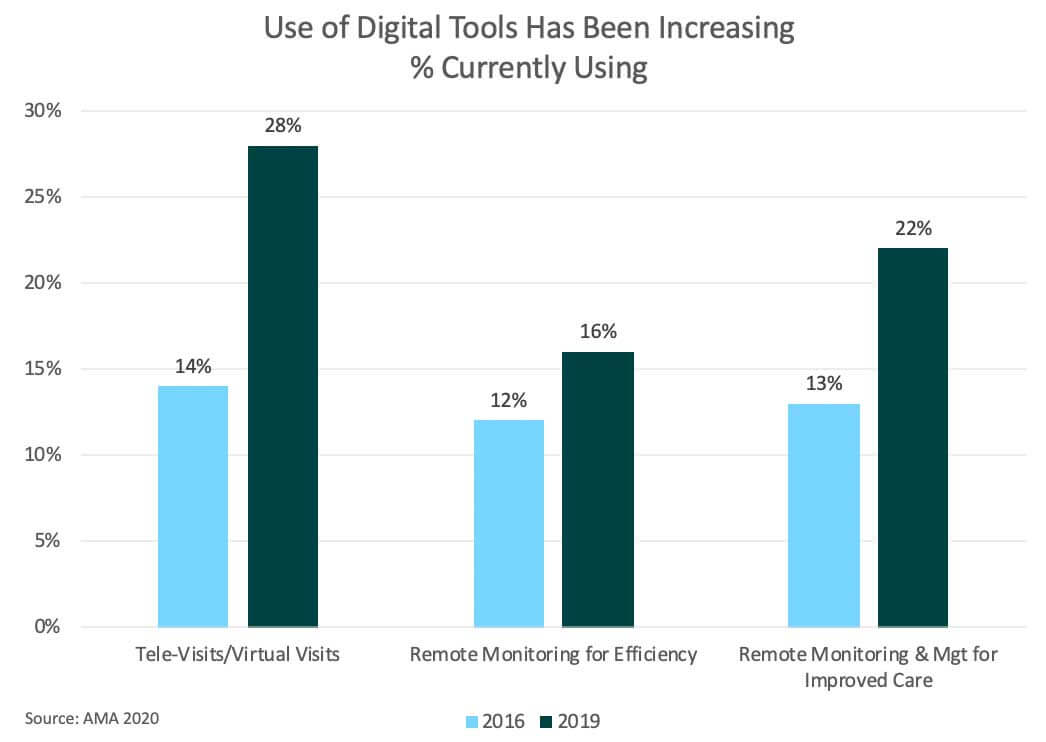
Remote patient monitoring is a leading trend in healthcare and supports digital therapeutics for chronic diseases such as heart disease and diabetes. Depending on the use case, devices connect through a secure internet connection from the home via a local home hub or through a cellular network. This new Internet of Medical Things (IoMT) ecosystem is driving adoption of digital health tools across the industry. Patient monitoring for efficiency, monitoring for improved care and tele-health visits, are proliferating and COVID-19 is the very catalyst driving adoption in the medical ecosystem at an accelerated rate.
COVID-19 changed the way patients are being monitored overnight. In the last week of March, the demand request for Medicare benefits from remote patient monitoring increased from 10,000 to 300,000 (WSJ). In fact, previous barriers to entry for Medicare benefits are lessening as the Center for Medicare and Medicaid Services (CMS) is expanding, providing more in-home health benefits including monitoring services and medical equipment.
Remote Patient Monitoring for In-home Caregivers Including Family Members
Every 11 seconds an older adult is treated in the emergency room for a fall and every 10 minutes an older adult dies from a fall. In fact, falls are the leading cause of fatal injury and the most common cause of nonfatal trauma-related hospital admissions among older adults. The annual cost in the U.S. these falls is over $50 billion (CDC).
For older adults, falls can lead to an erosion of health and bring on additional life changes. Receiving needed medical attention after a fall is essential to achieving the best outcome. Preventing falls or identifying other life safety conditions is a crucial component to enable many seniors to live at home longer as they age “aging-in-place” or AiP.
Additionally, the market has seen many new product and service applications to assist caregivers to monitor the activities of daily living (ADL) for the seniors in their care. The use cases for these products are becoming very relevant as people shelter in place and use similar technologies.
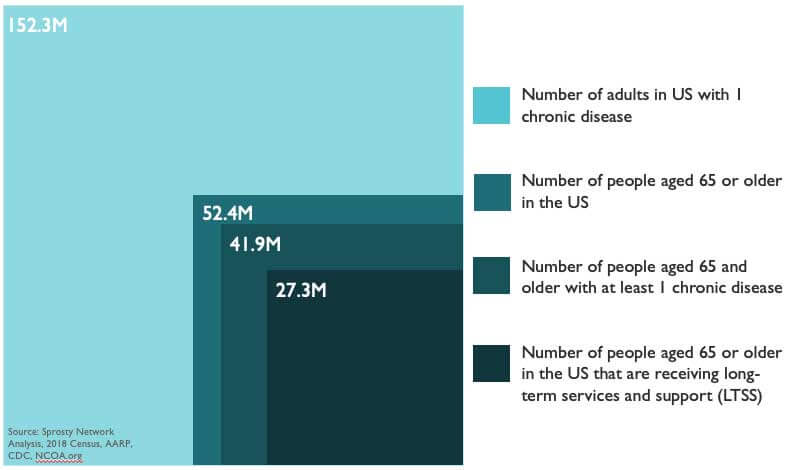
Providing caregivers automated notifications of changes in people’s normal daily activities helps them proactively identify risks and intervene before trauma incidents occur. Much attention has been paid to devices, measurement and analytics technology, but the remaining question is who is actually monitoring those in need and how? Often, the answer is the family. In 2017, an estimated 41 million family caregivers dealt with the implications of an unpaid economic cost of approximately $470 billion (AARP) in long-term service and support (LTSS). Moreover, the support and monitoring provided by family members frequently happens as the result of an emergency event. This is also the costliest of such incidents in terms of time and stress.
The demand is growing for professional monitoring that provides peace of mind and convenience to caregivers. This type of care can be provided at a fraction of the cost of LTSS alternatives. The global remote healthcare market is expected to reach $11 billion in 2020 and grow at an estimated CAGR of 33% from 2019 to 2027 (Arizton, July 2020). Supporting this growth is favorable government regulations and reimbursement programs, consumer adoption and comfort with technology, surge in virtual visits, and the emergence of new challenges driving by the pandemic.
COVID-19 compounds this increasing demand because this highly contagious disease severely limits, and in many cases prevents, caregivers from providing direct caregiving support. Importantly, customers are willing to pay for (Strategic Analytics) peace of mind related monitoring. A study by the University of Pittsburgh found that 80% of people surveyed are willing to pay from $50 to $70 for monitoring depending on specific service levels and types of assistance provided.
Patient monitoring is not limited to ADLs as the industry has rapidly accelerated remote patient monitoring for those with chronic disease. According to the CDC, 6 in 10 adults in the U.S are living with one chronic disease and 4 in 10 are living with two or more. Chronic diseases such as heart disease, diabetes, chronic kidney disease and Alzheimer’s are some of the leading drivers of the nations $3.5 Trillion annual health care costs.
AiP caregiver solutions have many benefits, including greater life expectancy and potentially lowering family caregivers stress, are becoming a reality as caregiver and medical professional decisions are now based on information variables linked to technology. This also removes certain financial constraints that would otherwise accompany reactive care based around emergency response and in-patient care. These solutions are also scalable, as sensory based technology allows persistent datat monitoring that enables physicians to target and identify issues before they become life disrupting.
5G is an Emerging Enabler of Faster and Less Costly IoMT Connectivity
Patient monitoring is not without its challenges, particularly in regards to connectivity. Data usage for remote patient monitoring is dramatically accelerating as patients, physicians and consumers are becoming more accustomed to the virtual experience. Today, most monitored chronic disease solutions are relatively simple with respect to the amount and frequency of data transmission, e.g. kilobytes 1-2 times daily. With newer remote monitoring technology, data is going to be measured in megabits and gigabits as edge computing and high-speed wireless 5G networks will allow for better and more comprehensive remote monitoring services. Real time (streaming) EKG for patients with heart disease, and blood sugar readings for diabetes are just a few examples of new remote patient monitoring services.
For service providers, remote patient monitoring is a new component of the value chain and allows for doctors, clinicians, and even remote monitoring centers to recognize new revenue streams as services are provided to an expanded user base. These solutions are getting to scale quickly so return on capital is happening at a faster rate and there are numerous third-party software-as-a-service (SaaS) solutions that allows service providers to quickly get to market with limited capital expenses.
Implications
MOBILE OPERATORS: By providing highly reliable connectivity, data security and easy home setup, mobile operators are positioned at the nucleus of evolving remote patient monitoring solutions. Where previously the cost of wireless transport was a barrier, service pricing is no longer a gating factor and the benefits that accompany wireless connectivity, such as the enhanced coverage and speed of 5G, create a significant opportunity for mobile operators to take a significant share of the market. Regardless of what underlying solutions or devices are used for remote patient monitoring, all will require a strategic partner to help them navigate the challenges in wireless networking to create seamless customer experiences. Remote patient monitoring devices and solutions providers need to start thinking about connectivity as a strategic capability and not simply a component cost of service.
RETAILERS: CDM is a significant opportunity for retailers such as Walgreens, Walmart, and CVS. They must first focus on using their unique assets to make it easier for their customers to gain access to these “digital prescriptions” by integrating them into their mobile apps, online and in-store experiences to educate and inform. These trusted brands are already the consumer’s go-to channel for free education on health, and the pharmacist is known as a trusted advisor, so it only makes sense that they provide the curation, advice and provisioning of these solutions. The business model could be compelling for the key stakeholders should the retailers decide to add value here. It would simplify the process for the payor patient, primary care physician and the device/solution provider if the retailers would staff their pharmacies with the caliber of talent required to fulfill these solutions. The key for retailers is gaining assess to the funding from the CPT codes and developing a flexible staffing model to support such a high-touch experience. The new Current Procedural Terminology (CPT) codes that allows for the billing and reimbursement of certain remote patient monitoring services has created a feeding frenzy of start-ups supporting RPM. The good news for retailers it that there is no clear owner in this new value chain. The bad news is that if retailers do nothing different in this space, they are ripe for disintermediation. ds
As customers become accustomed to virtual medical care, retail will play a pivotal role in curating and serving customers. Best Buy is already known as a market leader in technology services via their Geek Squad, and has named Best Buy Health as an initiative that will fuel their growth. Translating that technology leadership in service to those adopting remote patient care and management is something customers would expect from Best Buy.
UTILITIES AND ENERGY COMPANIES: For utilities, customers will look to them for solutions in connected health and remote patient monitoring as their brands stand for trust and reliability. Each of these are critical in a consumers decision around what home health solutions they should adopt and whom they should buy from. Utilities have the opportunity to play a direct role in the value chain by providing remote patient monitoring solutions for ADL and chronic disease management, and/or as a channel partner to others. As utilities look to get behind the meter and play a more active role for the customers, connected health is an opportunity that should not be overlooked.
CONNECTED MEDICAL DEVICE COMPANIES: For the more than 150 million people in the US living with a chronic disease, many require the use of medical device to manage and monitor their condition. From insulin pumps to heart monitoring devices the trend is towards connectivity. Historically, the companies that design and build these devices have not viewed connectivity as a strategic capability, but a cost center to support data collection and analysis only when medically necessary or when in-person patient consultations where not possible. These companies were disintermediated by the medical professionals that maintained a direct relationship with the customers and resulted in a limited opportunity to build relevance in a customers life. With todays connected medical devices, medical device companies have an opportunity to play a broader role in serving customers, creating new revenue streams and relationships that allow them to be more relevant. These companies need to start looking at connectivity as a strategic capability, and build relationships with mobile operators that can help them plan around newer mobile technologies such as 5G and to manage connected medical devices for a better overall customer experience.
Summary
COVID-19 has driven the awareness of remote monitoring for health, home peace of mind, and security. New norms are being formed in the way consumers think about receiving even the most private and sensitive of services and are turning to solutions from trusted providers that they are already doing business with as well as new market entrants. Those companies that can deliver winning customer experiences by demonstrating that they are easy to do business, willing to put the customer first and be trusted will continue to serve customers long past COVID-19 and into the future.