

Most utility and telecom providers are not falling short due to a lack of discipline. They are disciplined. They know how to deliver reliability, manage risk, deploy capital, and operate within complex regulatory environments. Those capabilities remain essential.
But they are no longer enough.
What has changed is the standard customers bring to every interaction. People no longer compare their utility or telecom provider only with other regulated operators. They compare it to the best experience they have had anywhere: the bank that resolved an issue in minutes, the retailer that made a complex transaction effortless, or the digital platform that anticipated their needs before they asked.
Reliability remains essential but is no longer a differentiator. Customer expectations have risen, as reflected in ACSI scores showing declining satisfaction in utilities (74/100 in 2025) and weak telecom performance in areas such as repair timeliness and service ease, raising the bar for regulated operators.
This creates a new leadership challenge: can regulated enterprises orient their decisions, priorities, and investments around the customer rather than the organization’s internal logic?
In practice, that often begins when leaders recognize the need to address foundational friction so broader transformation efforts can succeed.
The financial consequences are now measurable and direct. In June 2025, the New York PSC alone reported $28.9 million in penalties and revenue adjustments tied specifically to poor customer service. That number will grow as performance-based regulation spreads. Regulated enterprises that continue treating customer experience as a support function rather than a strategic operating model are no longer just risking reputation. They are risking rate cases.
This is a pattern I have watched play out across organizations. When I was running customer centricity at Best Buy, first as founder and CEO of Best Buy Mobile and then overseeing the broader customer centricity operating model, the transformation did not take hold until it stopped being a customer team initiative and began shaping how every function made decisions. That work became a Harvard Business School case study. The lesson was not about Best Buy. It was about how customer centricity either changes a company’s operating system or quietly fades into a standing agenda item.
The leaders who will stand out in the next era of utilities and telecom will act on three imperatives. AI does not replace them; it accelerates their execution.
Here is what that looks like in practice.
1. Make customer centricity an operating principle, not a side initiative
Customer experience is still too often treated as a side effort. It is assigned to the contact center, digital, marketing, or a transformation office. That is usually where momentum begins to fade, because customers do not experience the organization as separate functions. They experience a single journey.
That is why the concept of Intelligent Customer Experience should become an operating principle, not a side initiative that runs alongside the business.
This becomes real when every function understands how its decisions affect the end-to-end customer journey. It becomes real when customer outcomes are reviewed alongside financial and operational outcomes, when investment decisions are tied to removing friction, and when leaders ask not only whether the organization executed efficiently but also whether the experience was clear, fair, and easy for customers to navigate.
This is not a softer lens on the business. It is a more strategic one.
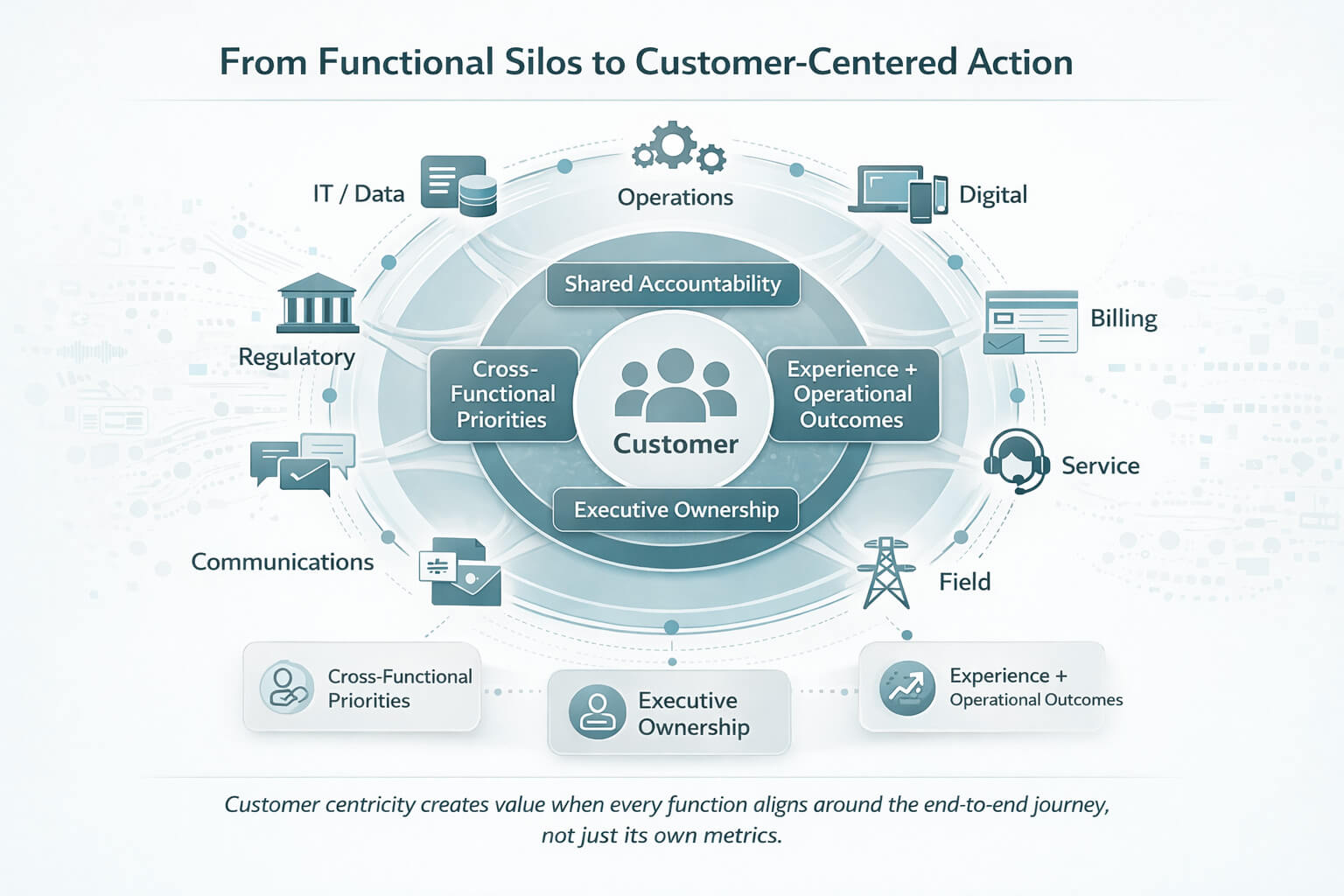
In utilities and telecom, most frustration does not stem from a single dramatic breakdown. It builds through accumulated friction: a confusing bill, an outage update that is technically accurate but not helpful, a service issue that gets handed off too often, a repetitive authentication process, and a policy explanation that makes sense internally but not to the person receiving it. None of those issues may seem defining on its own. Together, they define the relationship customers have with the company.
When customer centricity takes hold, the leadership conversation shifts. The enterprise stops asking only, “How efficiently did we execute?” and begins asking, “What did this feel like from the customer’s perspective, and what does that mean for how we operate?” That shift changes priorities, sequencing, governance, and accountability.
Without visible executive ownership, customer centricity remains just talk. With it, it becomes part of how the business runs. That was one of the clearest lessons from Best Buy and from a century-old Gas & Electric IOU [hot link to case study page] we worked with over several years: progress accelerated only when leadership prioritized customer centricity.
2. Modernize listening: let AI surface the signal, and let employees turn it into change
Most organizations no longer struggle to gather customer feedback. What they struggle with is interpreting it quickly, across channels, and with sufficient operational context to act on it.
In regulated industries, signals are everywhere: recorded calls, chat transcripts, billing disputes, outage complaints, field notes, digital journeys, complaint logs, service interactions spanning multiple systems, and frontline employee observations about where customers consistently get stuck. The challenge is no longer accessing feedback. It is turning the large volume of signals into clear insights.
This is where AI changes the game.
AI can now analyze interactions across the enterprise and surface recurring pain points, emotional intensity, language patterns, friction frequency, and escalation triggers much faster than traditional survey cycles or manual review. It can identify which issues recur most often, where frustration is concentrated, and which moments are most strongly linked to confusion, distrust, or escalation.
Many organizations still have blind spots in key customer channels. J.D. Power’s 2025 utility digital experience study found that 32% of utility websites and apps fail to meet basic navigation and design standards, and only 16% provide meaningful, proactive tools. Customers are forced to do too much work to get what they need.
But AI does not replace Voice of the Customer through the Employee (VoCE). It modernizes VoCE by making customer signals easier to detect at scale while making employee insights more actionable.
AI can detect the signal, but it cannot fully explain the operational reality behind it. It cannot tell leaders why a billing issue keeps resurfacing across channels, why policy contradictions create unnecessary contacts, or how a handoff breaks down for both the customer and the employee trying to resolve it. That is why frontline teams remain indispensable.
That was true at the century-old gas & electric IOU we worked with. Early frontline input did more than confirm that satisfaction was low. It revealed why the organization could not simply layer new initiatives on top of the current state. Employees were absorbing the consequences of broken experiences every day. They knew where the friction lay, how customers were reacting, and why basic issues had to be addressed before anything new could take hold.
That is the modern listening model: AI continuously surfaces the signal, employees interpret it with human and operational context, and the organization gains a clearer, more actionable view of where friction matters most.
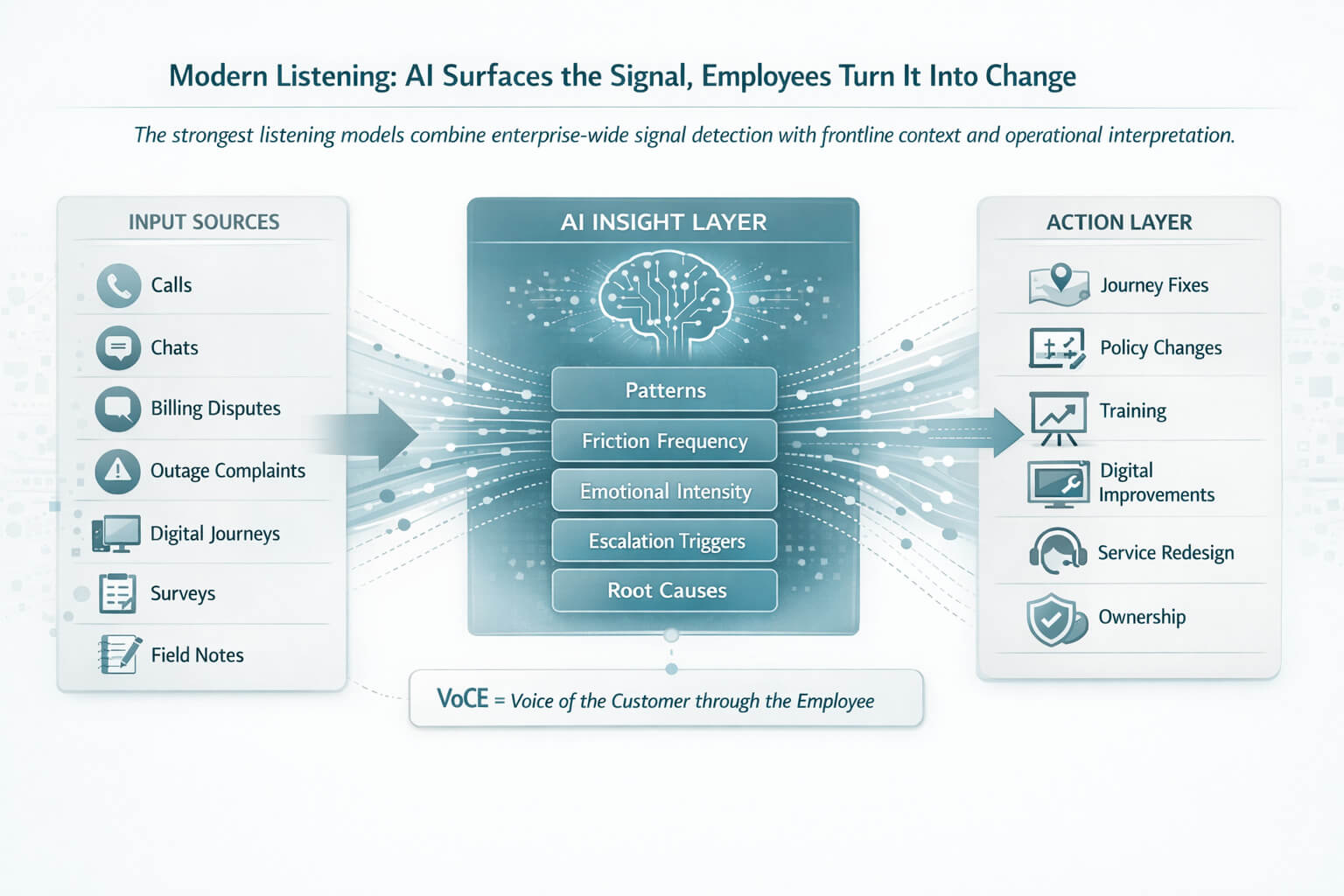
This also changes the employee experience. In many regulated organizations, frontline teams have spent years serving as shock absorbers for broken processes. They apologize for confusion they did not create, work around failures they cannot fix, and carry the emotional weight of customer frustration without sufficient authority or visibility to address the underlying system. When AI gives the enterprise a clearer view of recurring friction and employees are invited to diagnose and redesign it, frontline insight shifts from anecdotal to operationally actionable.
That is when listening becomes more than a reporting exercise. It becomes a mechanism for coordinated change.
3. Govern the experience through journey discipline and activation
Many organizations still treat journey mapping as a workshop output. It is used for alignment or presentation, then filed away as the organization returns to its regular routines. That is one of the main reasons customer experience efforts stall.
Customer journey mapping creates enterprise value only when it becomes a discipline and directly involves the team members who interact with the customer as change agents.
Journey discipline gives the organization a structured way to define lifecycle stages, surface moments that matter, pinpoint where friction concentrates, and connect those pain points to the people, processes, policies, and technologies behind them. More importantly, it creates shared visibility and a basis for prioritization. Leaders can move beyond debating which issues are loudest internally and focus on the frictions that matter most to customers and to enterprise performance.
That has practical implications across the business. It shapes digital sequencing, contact-center design, billing simplification, outage communications, service handoffs, field coordination, and how cross-functional teams work together. It turns insight into a roadmap rather than just a diagnosis. At the same utility, journey discipline helped turn customer pain points into concrete actions across billing, digital self-service, IVR and call-center experience, and outage communications, moving CSAT from 17th (out of 20) in the region to 2nd, reducing call volume by 17%, and establishing NPS in the 40 to 50 range, well above the utility benchmark of 0 to 30. Journey discipline also helped clarify where to start, who needed to own the work, and how progress would be measured over time.
This matters in telecom as well. ACSI’s 2025 study shows weak scores in repair timeliness, technician experience, and service ease, signaling broader journey breakdowns that require coordinated fixes across functions and channels.
Journey mapping is also where employee participation becomes especially powerful. Frontline and operational teams do more than confirm data. They expose where the journey fails in the real world and what it takes to remove friction. They reveal trade-offs, dependencies, and failure points that dashboards alone cannot capture.
Journey discipline reduces unnecessary debate by replacing opinion with evidence and isolated efforts with coordinated action. Complexity will always exist in regulated industries. The point is not to eliminate it but to prevent it from becoming an excuse for drift.
And that is where activation matters. Customer experience does not advance because an organization heard the signal. It advances when insight becomes a roadmap with ownership, cross-functional action, measurement, and visible progress.
The Leadership Inflection Point
Customer centricity in utilities and telecom used to be framed as a long cultural journey, with operational benefits expected to materialize eventually. That framing no longer fits the moment.
The three imperatives remain unchanged: listen better, align faster, and govern the experience through journey discipline and activation. What has changed is the speed at which friction is heard, understood, and acted upon. AI is the mechanism that compresses that cycle.
Used well, AI is not a replacement for the human disciplines described here. It makes them faster and more precise. AI surfaces the signal that used to take months to compile. It turns static journey maps into living tools, refreshed as new friction patterns emerge. It gives frontline teams better guidance in the moments that matter most, not to replace their judgment but to increase its value by removing the noise they must sift through to exercise it.
The leaders who move first on this will not be those who launch the most AI tools. They will be those who combine AI’s speed with the organizational disciplines AI cannot replicate: the willingness to listen to employees who absorb friction every day, cross-functional alignment to act on what they hear, and leadership commitment to make the customer experience a board-level priority, not a contact center metric.
That is what Intelligent Customer Experience means in practice. Not a platform. Not a framework you implement once and then shelve. An operating model that changes how a regulated organization listens, aligns, and acts, with AI as the accelerant and human judgment as the engine.